
Democracy and Its Pathologies
A Short Reflection on the PPE Society London Meeting

This is a short post that offers brief considerations about the recent PPE Society London Meeting. The regular schedule resumes this Thursday with the fourth and penultimate installment of my series of essays on the Coase Theorem.
I was in London last week where I attended the second PPE Society London Meeting. This conference is the European sister of the Annual Meeting that the PPE Society holds in New Orleans every year. As last year, the conference was organized at King’s College in the Strand, in the center of London. This is a very lively and lovely place with an incredible concentration of prestigious higher education institutions (LSE is a few meters away). The organization was again near perfect and the program attractive, with a great diversity of sessions and topics spanning across the three constitutive disciplines of the PPE community: economics, political science, and philosophy.
While there are PPE degrees virtually everywhere in Europe (with the sad exception of France), there was until recently no real place where PPE scholars could gather to present their research. The PPE Society has been organizing its annual meeting for ten years in the U.S. now, but nothing equivalent existed in Europe. Things are changing now as, on top of the European conference of the PPE Society, the PPE Network in Europe has emerged and is also organizing yearly conferences in Europe, though on a significantly smaller scale. This is relevant beyond the academic world. The crisis of liberal democracy makes the interdisciplinary approach of PPE more valuable than ever. It is widely acknowledged that this crisis has economic, social, cultural, and political causes that interact in complex ways. It’s not enough to work on them separately; you need to integrate them within an overarching framework to understand what policies and constitutional reforms are needed to address the pervasive discontent with liberal democracy. Unsurprisingly, many sessions at the London conference were, one way or another, concerned with this fundamental issue. The two keynote lectures by Peter Trubowitz, on Trump’s second presidency, and Erik Angner (a fellow Substacker), on the gap between how economics is perceived by the public and what it can really contribute, were both, from different perspectives, contributing to this endeavor. Erik’s lecture reminded me in particular of my early years as an econ blogger (more than 15 years ago!) when, in the middle of the financial crisis, economists were desperately trying to defend the relevance of their discipline.
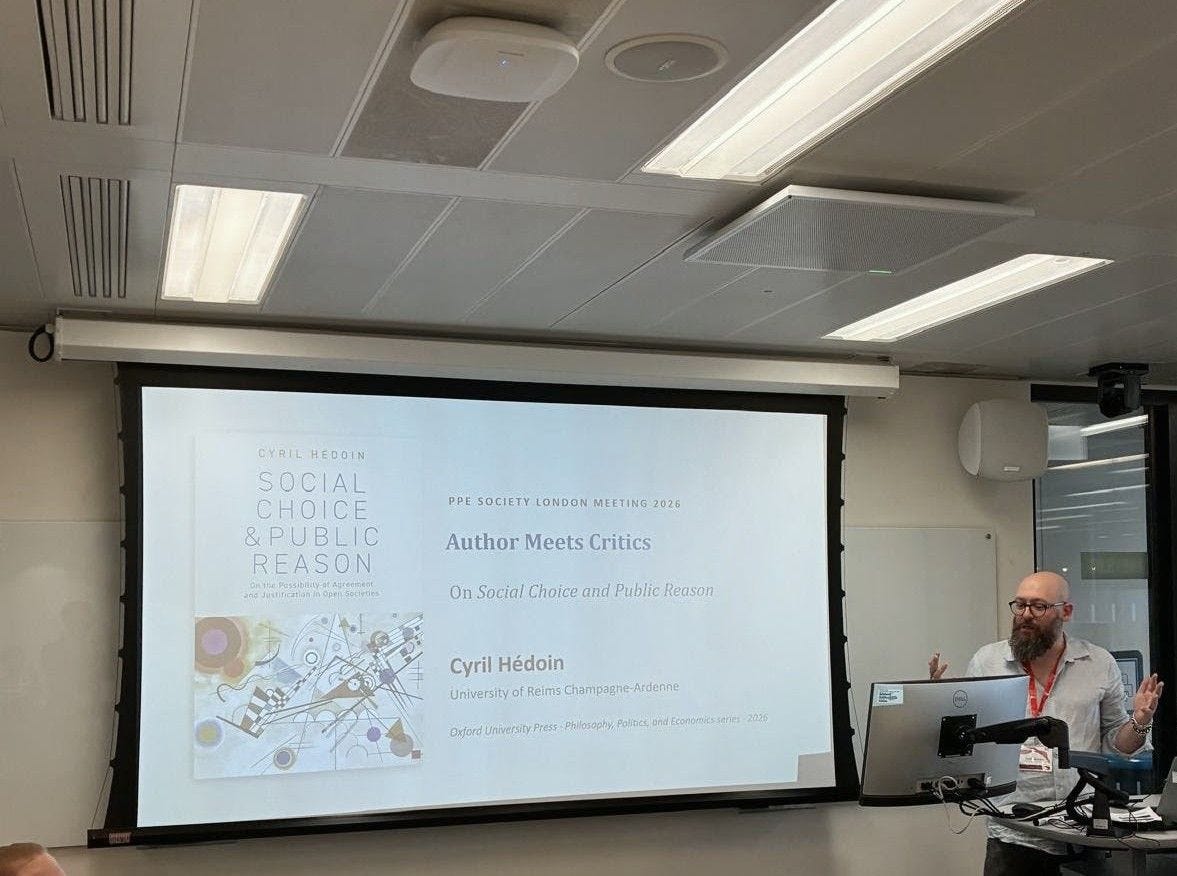
Presenting my book.
On a more personal note, I had the opportunity this year to present and discuss my forthcoming book Social Choice and Public Reason in an Author Meets Critics session. The timing was good, as my hardback copies arrived at home the very same day – the book is due July 21 in the U.S. and October 7 in Europe, while the Kindle version is already available. I received nice comments as well as friendly but serious pushback from my two discussants, Pablo Paniagua and Michael Moehler. The discussion revealed attractive perspectives to advance the framework and the thesis developed in the book, especially regarding the potential value of combining the idea of public reason with a more realist approach to politics.

Copies of my book have arrived, and I already have a first reader!
I also took part in a session called “Democratic Decline: The Political Economy of Political Risk Management“ with Pablo and Aris Trantidis. With hindsight, it would have been even more appropriate to call it “Democracy and its Pathologies” as the three talks were all emphasizing failures that undermine the legitimacy of concrete liberal democracies. Aris gave a public choice perspective on the form of “clientelism” that is inherent to democracy and how, as in Trump’s America, it can turn into a political regime where all actors are incentivized to defer to the demands of a dominant authority to literally buy its favors. In a co-written paper with Pablo, we argue that liberal democracies face a “bootstrapping problem.” We identify several pathologies (affective polarization, attention economy, …) that undermine the reasonableness conditions of democratic deliberation without which the exercise of public reason becomes impossible. Finally, in my paper “Institutional Designs and the Risk of Sectarian Public Reason,” I singled out the risk that the exercise of public reason takes a sectarian turn and subjugates citizens by disregarding their reasons and values. I explore how two distinct kinds of institutional democratic forms – open democracy and polycentric democracy – address the risk of sectarianism.
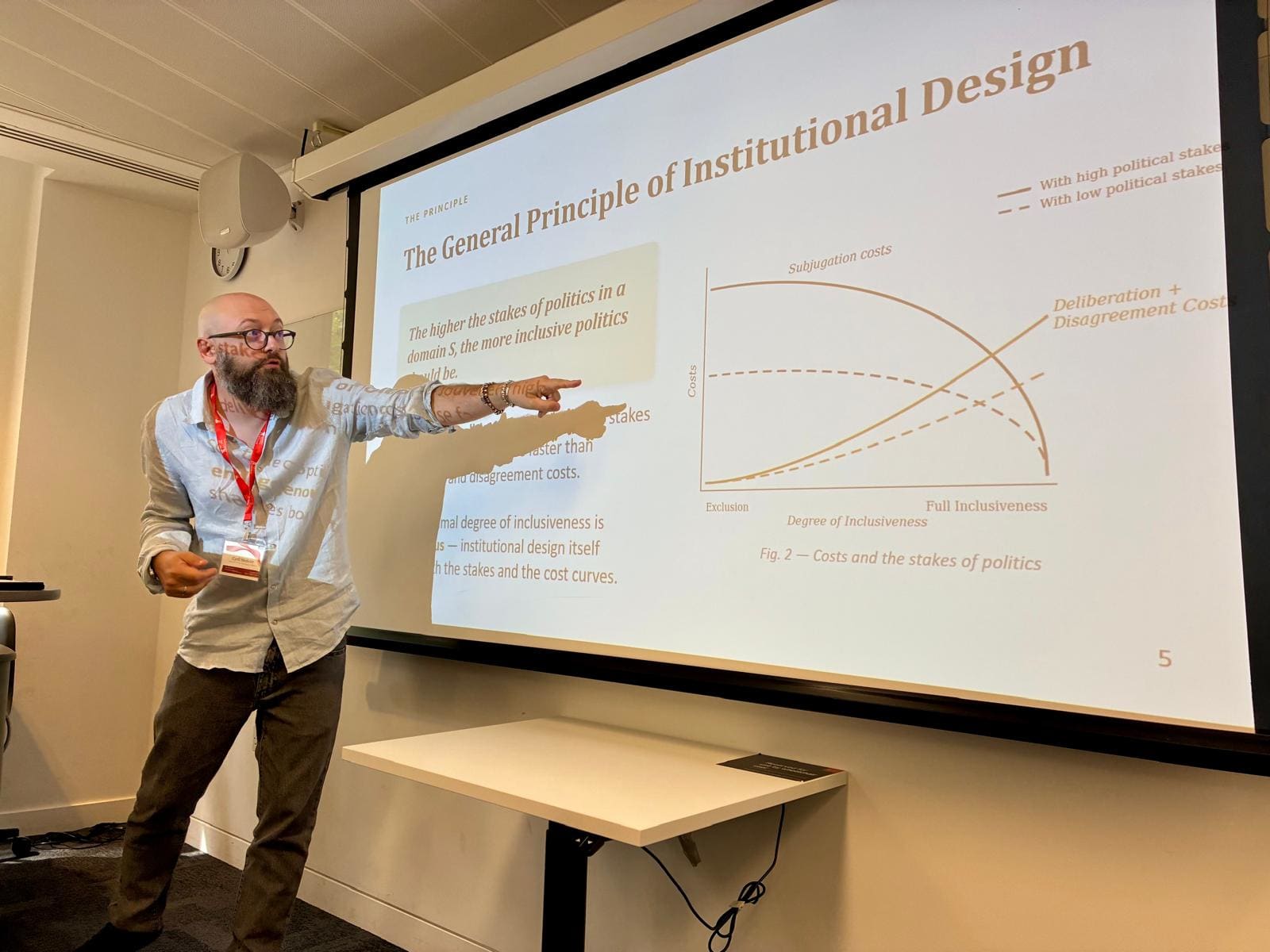
In action!
To end this unusual post, let me state that I was surprised and pleased to see that several participants seem to read this newsletter – I indeed had several discussions regarding the ongoing series on the Coase Theorem! Those readers will recognize themselves. Thank you very much!