
"Demoralization” and Moral Progress
With Insights from a Recent Pew Survey

Very short summary: This essay discusses “demoralization,” i.e., the process by which human practices cease to be subject to moral assessment, as a distinct form of moral change particularly relevant to liberal thought. Drawing on Pew Research Center surveys from 2014 and 2025, I analyze the evolution of moral attitudes across seven North American and European countries. The data reveals that the United States has undergone significant demoralization, while France has moved in the opposite direction, with implications for understanding how societies transition between moral frameworks.
It’s an understatement to that the notion of “moral progress” is a controversial and divisive one. Some people just deny the existence of anything resembling progress in the moral domain. There is moral change, but talking about progress is misguided because, by definition, you must assess change from a moral standpoint – hence, what is “progress” for some is “regress” for others. Others would point out that while clear cases of moral progress may exist, most of the time we are prone to mistakenly equate change with progress. Quite the contrary, we should be skeptical of moral change, because it may destabilize a long-established moral order that took centuries, if not millennia, to evolve. Even if moral norms can be disputed, the default assumption should be that traditions are overall beneficial and should be preserved. On the other hand, there are people who think that moral norms can be evaluated from an Archimedean point and that moral change can be assessed from an objective standpoint. The most optimistic believe that moral change can—and should—be engineered, and that actions can be taken to accelerate the course of cultural evolution.
The different views I’ve just sketched roughly correspond to the conservative/progressive divide. The divide reflects at the same time competing conceptions of moral progress and substantive moral beliefs. Not only are conservatives generally skeptical that moral progress exists—or at least can be engineered—but they are also more likely to accept long-standing moral norms; for instance, that homosexuality is wrong and should be forbidden. Progressives more readily endorse talk of moral progress and, in general, are prone to view recent moral changes (e.g., about homosexuality) as cases of progress. This is of course not surprising, at least if we talk about individuals who share the same social morality with the same moral history. But that’s not necessary: we may perfectly well imagine that someone accepts the idea and the possibility of moral progress but is skeptical that the moral changes we are witnessing today are genuine instances of moral progress.
I think liberals, understood here as individuals who consider themselves neither conservatives nor progressives, are the most likely to be in this last situation. It’s hard to dispute that many 18th- and 19th-century liberals were firm believers in the possibility of moral progress – liberalism is, after all, a product of the Enlightenment. But some were notoriously more cautious. If we compare the writings of John Stuart Mill and Alexis de Tocqueville, who were friends and whose views on the role of social opinion in democracy are very similar, we see emerge two different stances regarding morality. In the 20th century, authors like Isaiah Berlin and Friedrich Hayek largely tamed (from two completely different perspectives) the original liberal enthusiasm for moral progress. The best way to characterize the liberal position on this issue is as a form of skepticism: moral progress is possible but tricky to assert and, more importantly, attempts at engineering it can seriously backfire. On the other hand, they don’t see the fact that a moral norm has existed for decades or centuries as a source of justification for its maintenance.[1]
Liberals can also distinguish themselves from conservatives and progressives in a slightly different way. Consider any moral norm M about a specific human practice, e.g., homosexuality, gambling, extramarital relationships, and so on. There are ways moral change can happen and, eventually, for moral progress to be asserted. The first is that M progressively gives way to an alternative norm M’. Homosexuality may become “acceptable,” gambling may become “wrong,” and so on. The second is that the human practice of interest ceases to be the object of a moral assessment. There is no substitute for M. Individuals no longer think that the practice should be assessed from a moral standpoint and the practice is viewed as belonging to people’s own business. This is what is called demoralization.

“A Rake’s Progress - The Arrest,” William Hogarth (1734)
In their book The Evolution of Moral Progress, Allen Buchanan and Russell Powell present demoralization as a process in which “surplus moral norms” inherited from our evolutionary history (both natural and cultural) are progressively eliminated.[2] The fact that a domain of human life that was previously regulated by moral norms is no longer viewed as being morally relevant does not necessarily entail moral progress. It depends on whether the moral norms that are displaced were an unnecessary surplus or were fulfilling a genuine social function. Still, from a liberal perspective, demoralization is more likely to be conducive to moral progress than norm changes for at least two reasons.[3]
First, in light of liberals’ general skepticism about the possibility of assessing moral norms, replacing a moral norm with another one is likely to have ambiguous effects. To assess whether the new moral norm M’ is an improvement over the old norm M, you need some general conception of the good life. But people typically disagree about what the good life is, and that’s why evaluating moral progress is difficult. Talking about moral progress in this kind of case can even be perceived as sectarian because it implicitly entails imposing on everyone else one’s moral views. That’s why such efforts can backfire. Persons who see their worldviews ridiculed as “backward” are likely to react.
Second, while a norm change has ambiguous effects on human welfare and freedom, demoralization basically means that some behaviors are no longer viewed as demanding public justification. This is a clear case of improved individual (negative) freedom. If a society progressively sees homosexuality as “acceptable” or “unobjectionable,” that still means that people’s sexual practices are broadly viewed as subject to a moral assessment. Social morality (by contrast with personal ethics) is, by definition, public. Its norms are materialized through collective practices, and behavior that doesn’t respect them is the target of “reactive attitudes”: disgust, resentment, shame, guilt. Morality, whatever its content, has an oppressive and despotic dimension. Quite the contrary, demoralization extends individuals’ spheres of sovereignty. When it happens, other people cease to see one’s behavior as a source of moral/psychological externalities that should be socially, if not legally, regulated.
In practice, it is often difficult to know whether a given moral change is a proper case of demoralization. Interestingly, most large-scale surveys of moral attitudes, such as the World Values Survey, cannot identify it because they measure moral attitudes along numerical scales that don’t reflect the fact that individuals may be morally indifferent about an issue (or don’t see the issue as a moral one). An exception is the Pew Research Center survey, which categorizes people’s views on a range of issues in terms of three answers: “Morally acceptable,” “Morally unacceptable,” and “Not a moral issue.” Pew recently published a 25-country survey measuring moral attitudes on topics such as homosexuality, gambling, alcohol, or contraception. They released a similar survey, across 40 countries, back in 2014. Eleven years is not long but may be enough to identify some significant moral changes. I looked at 7 North American and European countries for 6 different issues to see whether we could identify interesting patterns. It’s far from conclusive – a more systematic treatment would be needed, but we all do as we can, given our opportunity costs. In any case, the first set of charts displays the evolution of the share of “Morally unacceptable” answers between 2014 and 2025:
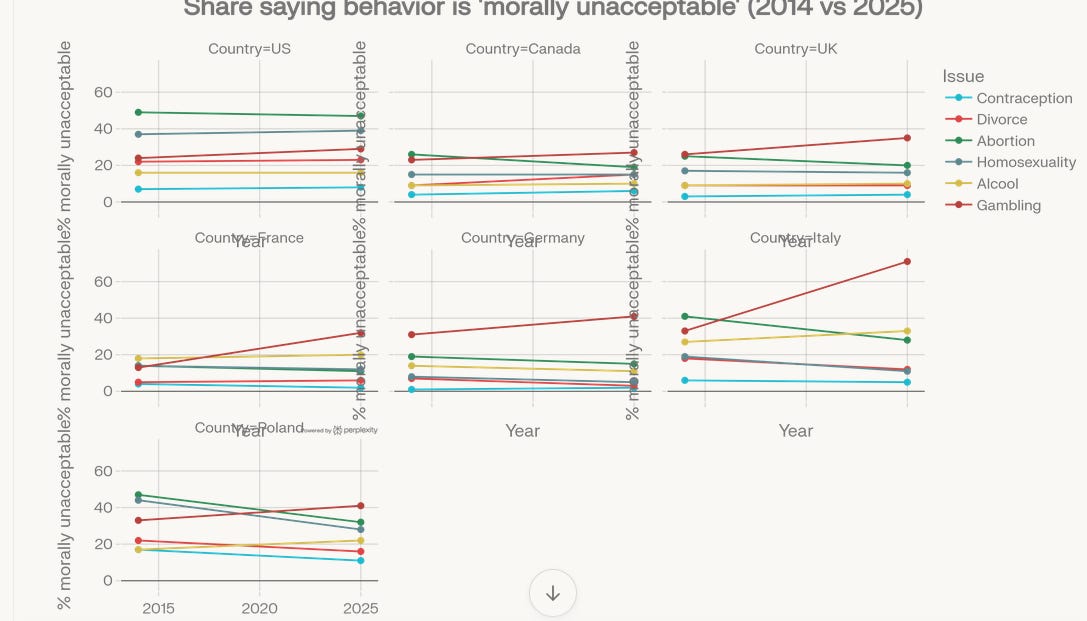
Let me just make two observations, not related to this essay’s topic but still interesting. First, gambling is seen as significantly more morally objectionable in all countries. Second, with the exception of Poland and ignoring gambling, the share of “morally unacceptable” answers are quite stable.
The second set of charts displays the evolution of the “Not a moral issue” answer for the same 7 countries and 6 issues:
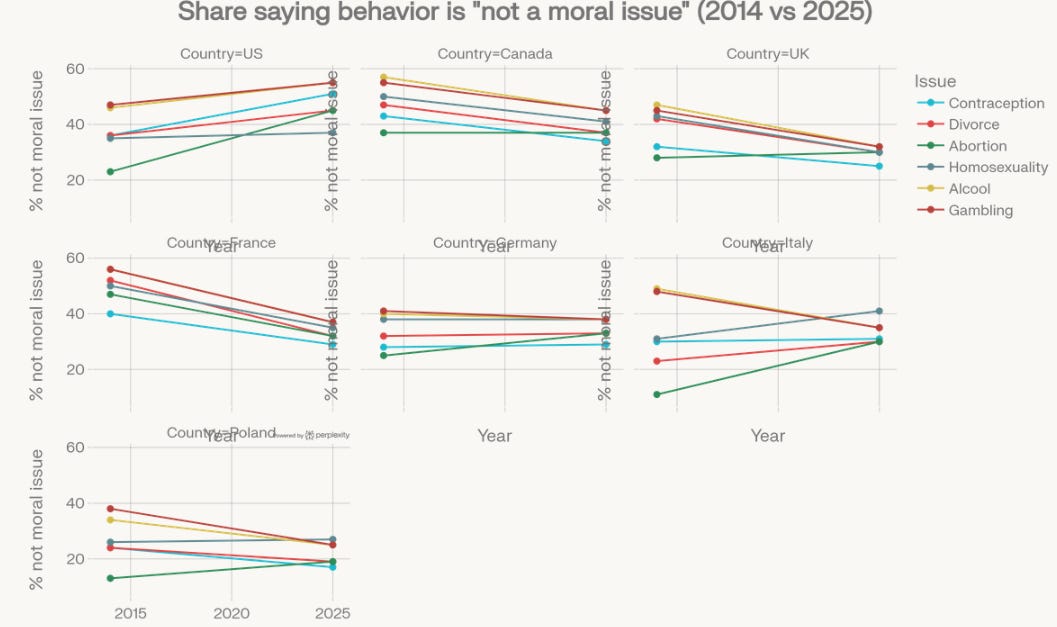
I find the results quite surprising and hard to explain. For all but one issue, the share of “Not a moral issue” has increased significantly in the US. But in countries like Canada and, even more, France, it has decreased, sometimes by more than 10 points. In light of the stability of the “Morally unacceptable” answers, that means that in those countries, people are more prone to judge a range of behaviors as “morally acceptable.”
If the “Morally acceptable” and “Not a moral issue” answers are merged, we’ll see no major changes in moral views in 6 of the 7 countries of this sample. But, at least in light of the above discussion, this is misleading. The US seems to have undergone a significant process of demoralization. By contrast, in France, the opposite happened. These patterns are not easy to interpret. They may be due to France’s greater degree of secularization combined with a relative and recent increase in the importance of religion (especially among younger generations), while the opposite is happening in the US. In the meantime, levels of “Morally unacceptable” answers remain significantly higher in the US than in Canada, France, and most other European countries. So, demoralization in the US may also be accounted for in terms of a reaction to a strong moral hold (again, presumably related to the relatively high influence of religion), while social morality is far more permissive in European countries. A hypothesis could be that the transition from a “conservative” social morality to a more “progressive/permissive” one may require demoralization as a first step, making the moral/not-moral distinction less relevant when the transition is complete. That is consistent with Buchanan and Powell’s theory of demoralization as an elimination of “surplus moral norms.”
Whether these patterns reflect genuine moral progress remains to be established. What is certain is that demoralization is an important aspect of moral change, one that is especially relevant from a liberal perspective.
[1] Even though he doesn’t talk about moral progress there, this is broadly the position that Hayek articulates in his essay “Why I am Not a Conservative” to distinguish his views from conservatives’. See F. A. Hayek, The Constitution of Liberty: The Definitive Edition (Routledge, 2020).
[2] Allen Buchanan and Russell Powell, The Evolution of Moral Progress: A Biocultural Theory (Oxford University Press, 2018), Chapter 8.
[3] Of course, even liberals may be skeptical about demoralization, at least in some cases. The disappearance of a moral norm can have adverse social effects as much as a change of norm.
The survey is mostly about religious taboos rather than moral norms in the way the rest of the discussion suggests. Nothing about hate, pride, cruelty etc. The finding that Americans consider their fellow citizens to be immoral almost certainly refers to these things rather than gambling and divorce
Are you sure that people understand what “not a moral issue” means when they answer the questionnaire? I wonder if might treat it as a way of avoiding the question, like “don’t know”. Or maybe as something intermediate between acceptable and unacceptable.