

Very short summary: This essay argues that the notion of “enlightened catastrophism” offers a useful perspective on the current French political crisis. It invites the reader to conduct a thought experiment about the French political situation: what should we do if we regard as certain the upcoming catastrophe combining a default on the public debt, the far right coming to power, and popular unrest that weakens the Fifth Republic? Enlightened catastrophism may not tell us what should be done in the face of the upcoming catastrophe, but it helps to fight complacency. It calls on liberals to display a genuine conservative radicalism.
Two decades ago, a few months after the September 11 attacks, the French philosopher (and then a professor at Stanford) Jean-Pierre Dupuy published a book titled Pour un catastrophisme éclairé (For an Enlightened Catastrophism).[1] The subtitle (“when the impossible is certain”) clearly states the main idea, which is that instead of analyzing future catastrophic events in terms of possibilities and risks, we should view them as inevitable and act based on this certainty. Like most of Dupuy’s books, it provides a thought-provoking and counterintuitive analysis based on an apparently simple idea. Here, most of the analysis relies on seemingly paradoxical thinking about time that borrows from Henri Bergson and Max Weber: by taking future events as certain, we allow those events to have a causal effect on our present behavior. This is likely to make us more responsive to future catastrophes than when we discount them on the grounds that they are not certain. The prophecy of doom is then meant to refute itself. It also offers an alternative framework to the so-called “precautionary principle” that promotes risk-averse but mostly incremental actions against potential catastrophes, based on an assessment of the acceptability of risks.
The catastrophes Dupuy is addressing range from terrorist attacks and nuclear wars to climate change. But the reasoning can also surely be applied to political catastrophes such as the one France is heading to. The country is in the midst of high school student protests that originate in the long-standing but probably increasingly serious problems that affect the French public education system, where a chronic lack of material and human resources causes bad teaching conditions and is likely to be partly responsible for France’s poor performance in the last PISA survey. These protests take place within what is already an explosive social and political situation with general popular discontent due (but not only) to very high fuel prices (some commentators are predicting the return of the Yellow Vests) while the government is virtually powerless due to the lack of a majority in parliament following the 2024 dissolution, as well as to increasingly tight budgetary constraints.
Regarding the latter, the public debt is another major cause of concern. It is now at 119% of GDP, higher than during the COVID pandemic. Even more concerning is the fact that the ratio has kept on rising fast since the end of 2023 in the absence of any major crisis, properly speaking – something that is strikingly new by the standards of the past four decades. The rise of interest rates means it will become increasingly hard to stop the trend. Higher interest costs are partially explained by the global economic state of affairs but also by the negative expectations about the French economic and political situation, as reflected by the spread between German and French 10-year yields, which has reached its highest level since 2012. Talk of a eurozone crisis triggered by France’s unsustainable public debt is now commonly heard.
Last but not least, all this is taking place as we are less than seven months from the first round of the French presidential election, which, according to most polls, has a fairly high chance of resulting in the qualification of two populist candidates, Marine Le Pen and Jean-Luc Mélenchon, whose mixture of economic views (e.g., lowering the legal age of retirement, cancelling the public debt held by the central bank [for Mélenchon]) and political attitudes (especially regarding the freedom of the press or the rule of law) is a recipe for disaster. These threats combine to make France’s entry into what The Economist called last year a “deficit-populism doom loop” a serious possibility. Financial markets are already punishing France for its inability to control its deficit and for the expectation that, should the far right win – very likely – the situation will get even worse. This is largely a self-fulfilling prophecy: the more pressure from financial markets, the less austerity is avoidable, which makes it more likely that populists will win the next elections, realizing the markets’ strongest fears.
Liberals and other center right/left politicians, intellectuals, and voters have until now been treating all these possible catastrophic events as risks. While the hypothesis that the next French president will be a (right-wing) populist is now considered a solid one by almost everyone, the risks of a public debt crisis spreading to the whole eurozone and of a popular revolt akin to the Yellow Vests turning into something more massive, to the point of shattering the political institutions of the Fifth Republic, don’t seem to be taken entirely seriously. Indeed, maybe they should not. But that’s precisely what makes the notion of enlightened catastrophism so attractive. When catastrophes are only perceived as possibilities, judging that the risks are limited is likely to encourage complacency, especially when the costs of acting against those risks are transparently high. This is true even when risk assessments are done properly based on all the available information. Risks are rarely assessed this way, moreover, and we should be aware that our judgments are likely to be biased.
The deficit-populism doom loop I mentioned above has all the characteristics of a Mertonian self-fulfilling prophecy.[2] Investors who expect France to lose control of its debt demand higher yields, which makes the debt harder to control, just as depositors who believe a solvent bank will fail end up bringing it down. Enlightened catastrophism makes a different kind of prophecy – a self-defeating prophecy. One might object that liberals who openly treat a French default as certain only add fuel to the markets’ fire. But in the Mertonian self-fulfilling prophecy, what investors are pricing is less the catastrophic outcome itself than the belief that nobody in the French political class will do what it takes to avoid it. A political class that visibly behaves as if the catastrophe were certain, setting aside its usual quarrels to protect what can still be protected, is precisely what would falsify the markets’ prophecy. Here, the point of announcing the worst is not to predict it, but to make it false.
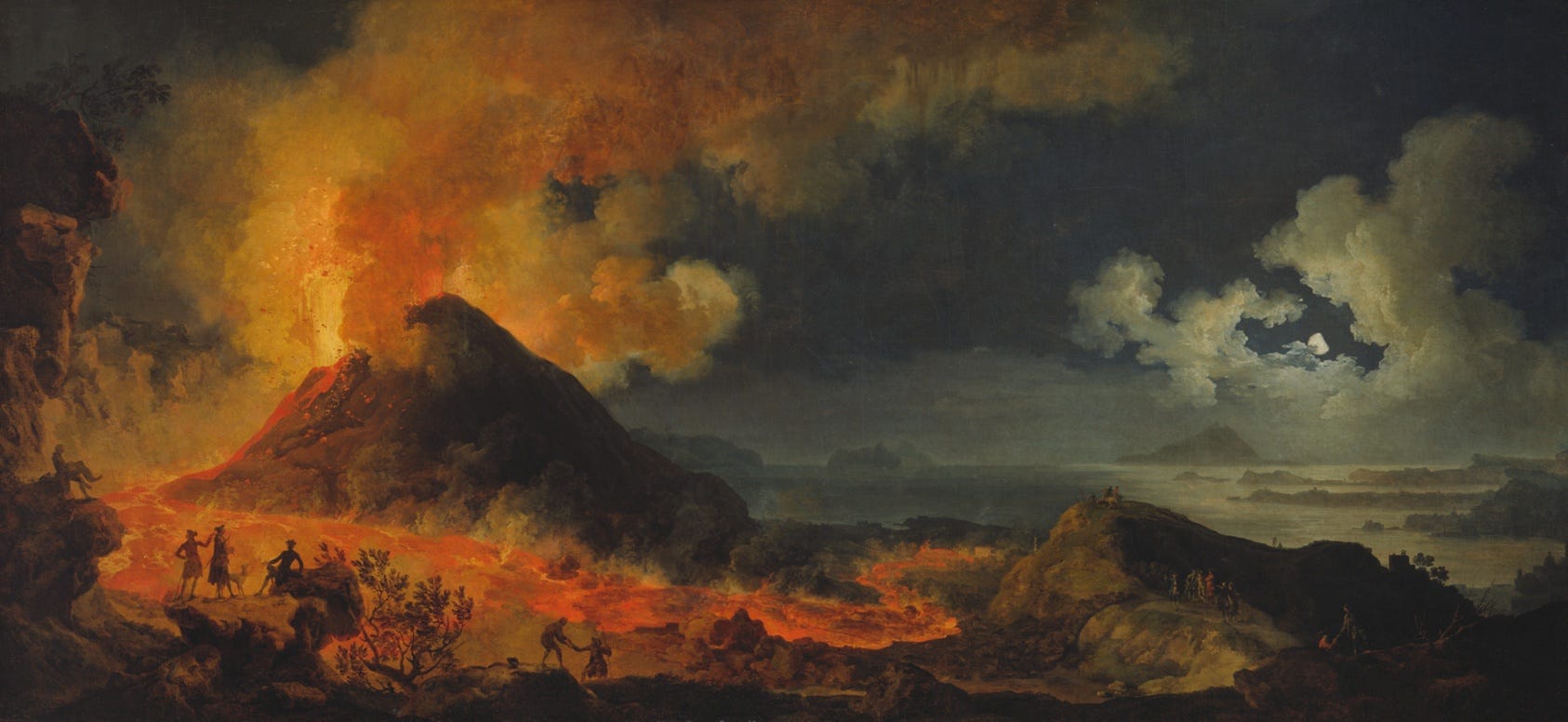
“The Eruption of Vesuvius,” Pierre-Jacques Volaire (1771)
So, in the spirit of Dupuy’s enlightened catastrophism, what should we do if we take the forthcoming political disaster as a certainty? Imagine, dear readers, that you know you will soon live in a country whose unsustainable debt has severely compromised the euro; a country that is no longer able to fund the very costly public services that, despite all their problems, still largely contribute to the overall quality of life; a country where, with the far right in office, the rule of law is compromised and individuals are treated differently based on their nationality and (supposed) religion; a country where journalists are routinely insulted and denied access to places like parliament because those in power don’t like their views (not too difficult to imagine: just cross the Atlantic Ocean); a country where from one day to the next, “social” rights that people had taken for granted no longer exist; a country where the great majority of the population suffers from a sudden loss of quality of life, with a significant fall in incomes; a country where violence, including in politics, is no longer properly regulated, putting almost everyone’s lives at a significantly higher risk than before.
This catastrophic scenario may invite two very different reactions. One is extreme cynicism and fatalism. For the lucky few who can afford it, this pushes toward “exit” strategies, like emigrating to a foreign country. For the rest of the population, this means political apathy and internalized self-deprecation. This is a real risk that comes with catastrophism, even in its enlightened form: if the future is already written, what’s the point of trying to change it? Fortunately, human psychology is such that complete fatalism, itself grounded in a belief in absolute determinism, is unlikely.
The other, and I think more likely, response is a new form of political radicalism, the direction of which is likely to diverge depending on one’s political sensibilities. This would surely be a strange form of radicalism that aims at preserving our most significant collective achievements – a genuine “conservative radicalism” to be opposed to the “revolutionary radicalism” of the far left and the “mythical conservatism” of the far right that dreams of returning to a society that never existed. This conservative radicalism will put things in perspective: in comparison to the upcoming political catastrophe, current disagreements regarding, e.g., whether pensions should be indexed to inflation look trivial. In the current context, the priority should be to establish a cross-partisan agreement that protects institutions and stabilizes the debt. Such an attitude recovers the original liberal spirit, committed to finding a way between reaction and revolution. It also displays an authentic ethics of responsibility.
Admittedly, enlightened catastrophism doesn’t tell you what should be done beyond this broad call for responsibility. It just helps to bring about a change of perspective that should convince everyone that something has to be done. It gives a sense of urgency and is a remedy against complacency. It makes it clear that radicalism can be justified and invites us to think seriously about what could be lost. Hopefully, it could help to shake a country, its population and its political class, paralyzed by their complacency, their certainties, and their absolute sense of security, if not of superiority.
[1] Jean-Pierre Dupuy, Pour un catastrophisme éclairé (Seuil, 2002). For an English translation, How to Think About Catastrophe: Toward a Theory of Enlightened Doomsaying (Michigan State UP, 2023).
[2] Robert K. Merton, “The Self-Fulfilling Prophecy,” The Antioch Review 8, no. 2 (1948): 193–210.
It's hard to see how this "conservative radicalism" you point to could arise in the current context of republican institutions hobbled by political paralysis. It may be that a detour through a phase that is somewhat less legalistic is necessary to break the logjam, but then you're in uncharted territory and who knows if we get back to "republicanism" as we mean it today? But is it even possible?
Specifically, let's contemplate a "Fascist coup" for a moment. I haven't followed French politics closely enough, but I don't believe that the National Front (I still call them that) has articulated a "non-republican" political program. Additionally, you need to apply force to overturn legal governments and I don't believe that the army and police are so much in the Front's pocket that they would go along, never mind act as its agents. So, no coup and republican institutions remain standing (even if pushed around some, as we have in the US). The Null Hypothesis is that the Front takes power...and nothing much happens because they don't know what to do. More likely, France becomes bankrupt (I mean, for real) and must be rescued by the IMF / foreign lenders, who impose economic austerity while the Front government blames foreigners for everything. Greece 2.0. Or am I oversimplifying?
This is the result of Presidentialism. Front national has been a relevant part of the country for decades and no political power was allowed to it, until it gets the all powerful Presidency.
A proportional parlamentarian France would not be in this situation.