
On Decline
A Value Pluralist Perspective

Very short summary: This essay discusses the idea of decline. Decline can be individual, e.g., an aging athlete whose performances are unavoidably decreasing, or social, i.e., a society that is increasingly unable to sustain its ways of life. However, while individual decline is grounded in biology and can be objectively ascertained, social decline is always value-based and a matter of how history is framed. Obsession with decline (“déclinisme”) betrays a form of historical fanaticism and is often conducive to extremism. Hence, social decline must always be analyzed in the context of value pluralism. That doesn’t mean that decline is necessarily a myth, as the case of Europe may illustrate.
What do LeBron James and Europe have in common? Here is one possible answer: both arguably are declining. James’s 23-year-long (and still counting) career is impressive in many respects, and especially for its longevity. At almost 42, James (who arrived in the NBA as a 19-year-old) is still an All-Star and one of the major players of a team that finished in the top-6 of the last regular season. Still, everybody agrees that James is no longer the player he once was and that he will never be again. Indeed, talk of James’s decline are not new – I distinctly remember that they started to develop when James returned to Cleveland after his 4-year stint with the Miami Heat. For the first time, James then started to show signs of physical decay and some of his statistics (especially his shooting percentage) were below their usual levels. Of course, James proved everybody wrong by winning the 2016 NBA title against one of the best teams ever, with what is arguably still today the best performance in NBA Finals all-time (and this is a Michael Jordan fan who is speaking).
The decline of great athletes has something fascinating about it, especially when, like James (or Messi, Federer, Nadal, Djokovic, and many others), they seem to be able to slow it down – for a time. Sports commentaries showing amazement at those athletes who keep performing despite the unavoidable loss of their capacities abound. In a way, a declining but still performing top athlete attracts more accolades than when they were in their prime, just because performing then seems less “natural” and to require more effort. When James was manhandling the Thunder or the Spurs at the age of 28-29, he was “gifted”; as he is still playing at an all-star level past 40, he is praised for his “hard work.”
As individuals, decline is something that we have all known, or will. For most of us, it will be less spectacular and visible than for high-level athletes, just because our performances are not quantitatively tracked and measured against others’. But as with athletes, we try to find ways to slow down the unavoidable. When I was in my twenties and even early thirties, I had a relatively high capacity to learn new theoretical tools and generally to teach myself on a broad range of topics. Today, I feel (if I’m honest with myself) that I’ve lost part of this ability. Fortunately, AI compensates – at least partially – for this loss. But whatever we do, the outcome is known in advance: we will progressively lose the capacities and skills that we have mastered because they are all ultimately grounded in our aging biology. While most of us would probably like to escape decline, we typically don’t perceive it negatively precisely because there is nothing we can do about it. We take it as a fact we have to live with. This is life, period.[1]
Now, consider social decline, i.e., the decline of specific human societies. Here, decline is more than a topic – it’s a genre in its own right. Oswald Spengler’s The Decline of the West is one of the most representative works in this historical and social scientific literature that analyzes societies through the decay of their institutions, culture, and moral character. Here, the concept of decline can be used for either of two purposes. First, it provides a frame to analyze past events that, put together within this frame, are given a particular meaning – these events are interpreted as symptoms of a broader historical movement that is retrospectively analyzed as a “decline.” Second, it provides a framework to analyze, if not predict, a society’s future path. When articulated, the two purposes combine into a genuine philosophy of history in which a society’s evolution is viewed in terms of a single movement where contingent events are all singular emanations of an historical necessity.
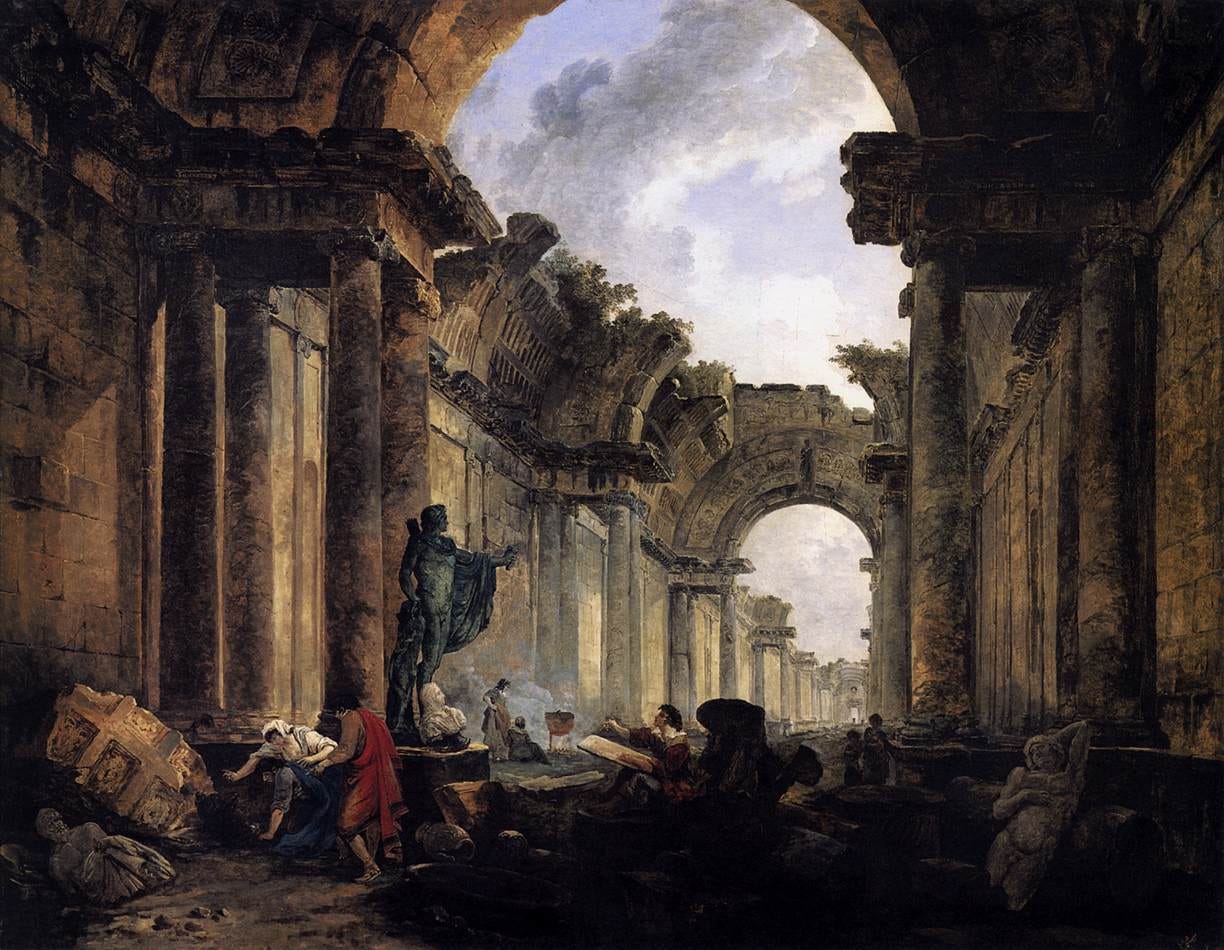
“Imaginary View of the Grande Galerie in the Louvre in Ruins,” Hubert Robert (1796)
There is a major difference between individual and social decline. Individual decline is unavoidable insofar as it results from biological decay. It is also objective, at least in the many cases where performances can be objectively measured and compared. Social decline lacks these properties. As Raymond Aron, following Max Weber, insisted throughout his career, any historical analysis is value-based. History only exists and takes shape through the value-based judgments of contemporary historians. To analyze the history – past or future – of a society in terms of decline is already to make a value judgment that says at least as much about the analyst as about the society that is analyzed. In some cases, as in Spengler’s The Decline of the West, social decline is analyzed in terms of an organicist analogy that gives it roughly the same properties as individual decline. Social decline becomes “natural” and “unavoidable.” But the analogy is itself value-based. The same applies if all forms of organicist analogy are avoided. Decline is always relative to some metrics that are not arbitrarily chosen. It always follows from a particular interpretation of historical events; neither of them (the interpretation and the events) is randomly picked.
Talk of (social) decline has been especially prominent in the case of Europe. The Draghi report on the future of European competitiveness is a warning that, unless critical policies are implemented at the EU level, European societies are doomed to lag behind the US and Chinese economies without any hope of catching up. Interestingly, the Draghi report doesn’t frame the European decline as unavoidable but nonetheless conveys the sense that Europe is following a trajectory that, unless something is done, leads to a relative, if not absolute, decrease in Europe’s wealth. Similarly, the nationalist account of Europe’s decline as framed by the “great replacement” theory reflects the view that value is to be found in Europe’s Christian origins.
Each account of social decline, as in the case of Europe, thus mirrors a particular judgment about what is valuable in the society that is perceived as declining. But, because no society has an agreed metric and agreed telos, talk of decline must face value pluralism. A society can decline with respect to some values but not to others. Speaking of decline – and making policy recommendations to counteract it – ultimately reveals a radical choice about what matters, a choice that cannot be rationally ascertained and is likely not to be shared by others. In this sense, déclinisme (the genre pushed to its extreme) is a form of historical fanaticism in Aron’s sense. What makes déclinisme fanatical is not that it chooses values, but that it collapses a plurality of values into a single master-value and reads a society’s entire history as one necessity measured against it. That’s why déclinisme often leads to radicalism and extremism.
Both the Draghi report and the great-replacement narrative say that something is being lost without which Europe cannot continue. What separates them is monism. Draghi’s concern is offered as one consideration among the several goods Europeans hold together – decline threatens the material and institutional base on which freedom, equality, and welfare all draw; the great-replacement narrative elevates a single ethno-religious value and subordinates every other to it. One claim survives value pluralism; the other is built to abolish it.
Now, this pluralist account of social decline does not entail that decline is a myth. There are objective conditions of social decline because some goods are load-bearing preconditions for others. Value pluralism doesn’t reject the possibility that the realization of some values depends on the realization of others – for instance, the exercise of freedom may require securing social order. In Europe’s case, the real question is not whether Europe is declining but whether it is jeopardizing the very conditions for its own valued form of life. The dominant forms of life in Europe (and in the West in general) rest on the accumulation of various forms of capital (institutional, demographic, technological) that permit the realization of our overarching values (notably freedom and equality). Worries about an aging population or productivity growth slowing down are justified insofar as they threaten Europe’s ability not only to increase this capital, but even to simply replace it – it can be as mundane as the fact that the first thing that a foreign tourist will encounter in a Parisian train station is often an escalator that doesn’t work. If economic and geopolitical capacities are what enable the goods that Europeans prize so much (freedom, material welfare), then there is indeed a case for talking of European decline.
[1] Sure, there are people who refuse this fate. Transhumanists are precisely the category of persons who don’t accept the fact that decline is unavoidable. Their positive belief is that there are technological ways to stop decline. But their more fundamental, normative belief is that decline is bad and ought to be stopped.
The individual athlete qua athlete clearly declines by his forties, but that doesn't mean the person is in decline. The pluralist account applies to individuals. Some athletes find their true calling after their athletic career.