
Pluralism and Progress
On Bernard Williams’s “Liberal Equation”

Very short summary: This essay reflects on Bernard Williams’s account of pluralism as a form of moral and political progress. I connect Williams’s view of pluralism with his claim that liberalism follows from the satisfaction of the demands of political legitimacy in the context of modernity—what I call Williams’s Liberal Equation. If Williams is right, pluralism, while not a brute fact, is a feature of modernity that cannot be dispensed with. Any political attempt to reject pluralism, or even to tame it, entails the rejection not only of liberalism but of modernity itself. Post-liberals should take note.
Pluralism is both a constitutive feature of liberalism as a doctrine and a defining feature of liberal society. For many liberals, the elevation of pluralism as a desirable and valuable feature is what distinguishes liberalism from virtually all other political views of the good society. Pluralism is, in turn, viewed as a core characteristic of liberal society itself—a society in which different conceptions of the good, and even of justice, coexist in relative harmony. People disagree, but they are able to live together. They accept that others do not share their views about the good and the right, and they are willing, at least up to a point, to reconcile their own views with those of others. The institutions of liberal society sustain pluralism in two ways: first, they mitigate and adjudicate the conflicts that arise from this diversity of views; second, they encourage and facilitate the maintenance of that diversity and, correlatively, limit attempts to undermine it.
The link between pluralism and liberalism may even be stronger than this. For liberals ranging from Friedrich Hayek to Isaiah Berlin, the two go hand in hand. For Hayek, anything that falls short of liberalism at the economic level—that is, of free markets—entails imposing a hierarchy of values on everyone and disregarding the fact that individuals legitimately want to pursue very different ends.[1] For Berlin, the impossibility of ranking and realizing all values simultaneously accounts for the special status of negative freedom.[2] Even if pluralism and liberalism do not logically entail each other, there is a deep affinity between them. A society that acknowledges the normative significance of pluralism will inevitably acquire liberal features.
In this sense, one’s appreciation of liberalism may hinge significantly on how one understands pluralism. Yet it is not entirely clear what pluralism actually is. Is it a brute fact—an aspect of social reality that is independent of our perceptions and has always been with us? Is it an institutional fact—an aspect of social reality that depends on our beliefs and on how our society is organized?[3] Or is it a normative stance—a particular view about the nature of the good society? If one of the latter two options is retained, another question surfaces: to what extent is it good that pluralism has become so important in modern societies, or in our normative views about them? In other words, is the social and normative acknowledgment of pluralism a form of moral and political progress?
These questions are particularly relevant in the context of Bernard Williams’s essay “Pluralism, Community and Left Wittgensteinianism.”[4] Commenting on John Rawls’s theory of “justice as fairness,”[5] and more particularly on Rawls’s subsequent reinterpretation of it as a “political” theory,[6] Williams writes:[7]
“This aspect of the theory throws an interesting light on the new developments which emphasize the idea that justice as fairness is a particular answer to some peculiar problems of modernity. If justice as fairness does particularly well express certain fundamental aspects of human personality; and if it is a characteristic response to the conditions of pluralism rather than a timeless demand on all human agents living in any society anywhere; then the right conclusion will be that the conditions of pluralism particularly well express fundamental aspects of the human personality.”
Let me unpack the second sentence of this particularly insightful paragraph. The clause before the first semicolon essentially echoes Rawls’s early Kantian understanding of his own theory: that it formalizes the normative implications of what it is to be a human being. The clause between the two semicolons states that, on Rawls’s later interpretation, justice as fairness reflects the political culture and practices of modern democratic societies—societies that must face the “burdens of judgment” arising from the “fact of pluralism.” The final clause gestures at a relation between the fact of pluralism, which is central to Rawls’s political interpretation, and the account of human personality that underlies his more Kantian interpretation.
Williams seems to suggest that the third clause follows logically from the first two. If we label “justice as fairness,” “conditions of pluralism,” and “human personality” as 1, 2, and 3 respectively, the argument has roughly the form:
[(1 → 3) & (2 → 1)] → (2 → 3)
A few lines below, Williams observes that, if this reading is correct, Rawls’s account “would itself imply a certain conception of modernity to which Mill was well disposed: that at least so far as its pluralism is concerned, it represents a form of progress from societies which, in contrast to the typically modern condition, were held together by some more unifying and concrete conceptions of the good itself.”[8]
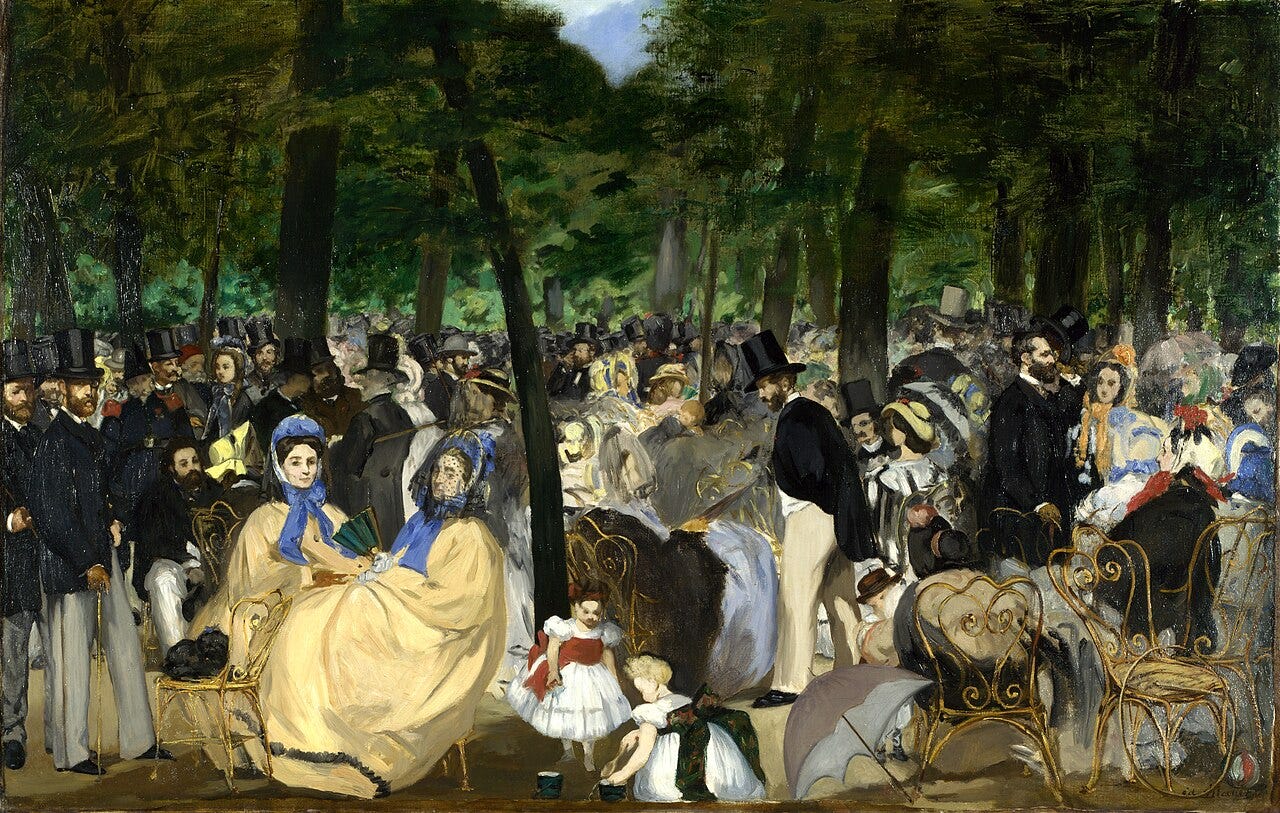
“Music in the Tuileries,” Edouard Manet (1862)
Williams’s point seems to be that, insofar as “human personality” has permanent features that can only be expressed under the “conditions of pluralism,” the normative and institutional acknowledgment of pluralism is a genuine form of moral and political progress. And since the conditions of pluralism are themselves a product of modernity, modernity itself has contributed to moral and political progress. The puzzle takes a particularly interesting shape when we connect this piece with other aspects of Williams’s political realism. In his essay “Realism and Moralism in Political Theory,” Williams contends that any political community, and especially a state-based one, must satisfy a “necessary condition of legitimacy.”[9] This condition essentially consists in solving the Hobbesian problem of peaceful coexistence. Legitimacy demands more, however: the state must also provide a justification of its power to each of its subjects.[10] It is not my intention to discuss this additional condition here. The point is that, while Williams leaves open the possibility that several forms of political community can satisfy the conditions of legitimacy (LEG), in the context of modernity he claims that only liberalism can achieve this. As he famously put it:[11]
LEG + Modernity = Liberalism
Let me call this “Williams’s Liberal Equation.” What Williams means by modernity is not always entirely clear, but it is clear enough that the conditions of pluralism are part of it. In this sense, Williams’s political writings tend to reveal a larger picture that places liberalism at the top—or at the end—of a genealogy of moral and political progress, even though his political realism fully acknowledges that illiberal forms of political organization can also be legitimate in the eyes of those subject to them. Illiberal legitimacy, however, seems to imply a rejection of pluralism, and more generally of modernity.
Williams’s reading of Rawls may be disputed, since it is unclear that the quasi-logical reasoning in the passage above is correct—it rests entirely on the possibility of combining Rawls’s Kantian and political understandings of his theory.[12] It is enough, however, to substitute any theory of justice that insists on the normative relevance of pluralism to reach a similar conclusion. And this conclusion is not benign, especially in light of the contemporary audience for post-liberal fantasies. Post-liberals do not necessarily ignore or reject pluralism; indeed, they sometimes invoke it as an argument against the universalistic pretensions of liberals and liberal societies.[13] It is easy to invoke pluralism in order to reject liberalism’s implicit hierarchy of values (because liberalism does have one) and to justify forms of life that depend on a different one. Yet if Williams is correct, rejecting liberalism entails rejecting pluralism, and modernity more generally.
Post-liberals and Williams, it seems, hold two different conceptions of pluralism and, relatedly, two very different views of how the demands of legitimacy can be satisfied. At best, post-liberals seem to treat pluralism as a fact implying that not all societies can adopt the same political organization, while legitimacy, on their view, requires taming pluralism within a given society in order to pursue a “common good.” Liberals, at least on Williams’s reading, tie the conditions of pluralism to modernity itself—not as something to be tamed but as something to be addressed in the most beneficial way possible. What Williams’s Liberal Equation implies is that, in a modern world, political legitimacy cannot be secured without accepting and taking advantage of pluralism—and that this is for the best.
[1]F. A. Hayek, The Road to Serfdom: Text and Documents—The Definitive Edition (University of Chicago Press, 1944 [2007]).
[2]Isaiah Berlin, Four Essays on Liberty (Oxford Paperbacks, 1990).
[3]For the brute/institutional fact distinction, see John R. Searle, The Construction of Social Reality (Simon and Schuster, 1997).
[4]Bernard Williams, In the Beginning Was the Deed: Realism and Moralism in Political Argument, ed. Geoffrey Hawthorn (Princeton University Press, 2005), Chapter 3.
[5]John Rawls, A Theory of Justice (Oxford University Press, 1971).
[6]John Rawls, Political Liberalism (Columbia University Press, 1993).
[7]Williams, In the Beginning Was the Deed, p. 30.
[8]Ibid., p. 31.
[9]Ibid., Chapter 1.
[10]Ibid., p. 4.
[11]Ibid., p. 10.
[12]Moreover, while Rawls speaks of the “fact of pluralism,” this cannot be understood as a brute fact if Williams’s own reading of Rawls is to make sense. Admittedly, Rawls never properly characterizes what he calls the fact of pluralism.
[13]Though not strictly speaking a post-liberal, such a stance is especially well represented by John Gray; see, e.g., John Gray, Isaiah Berlin: An Interpretation of His Thought, Revised edition (Princeton University Press, 2020).