

Introductory Note: Today’s essay inaugurates a symposium on the nature and raison d’être of Philosophy, Politics, and Economics (PPE), a field of study that has recently enjoyed a growing popularity. It is co-authored with Pablo Paniagua. Pablo is an economist, philosopher, and essayist. He is an Associate Professor and the Academic Director of the Master’s program in Philosophy, Politics, and Economics at Universidad del Desarrollo (UDD). He serves as a Research Fellow at King’s College London and Associate Editor of the journal Humanities and Social Sciences Communications. He is the author and editor of several books and more than forty articles, exploring governance, economic, and normative questions at the intersection of philosophy, politics, and economics.
As part of the symposium, I will publish each week in October commentary essays on this manifesto from Lisa Herzog, Sahar Heydari Fard, and Ryan Muldoon, as well as a final response from Pablo and I. So, stay tuned!
By Cyril Hédoin and Pablo Paniagua
In 1964, Nobel Laureate James Buchanan asked a deceptively simple question: “What should economists do?” His purpose was not to recommend useful research topics, but rather he wanted economists to reconsider the subject matter of their own discipline. Economics, Buchanan argued, should not be understood merely as the abstract science of choice or as the engineering-laden or technical allocation of scarce resources among competing ends. Economists should concentrate on exchange (broadly conceived), cooperation, and the institutional arrangements through which people reconcile their different purposes. They should examine not only market transactions but also the variety of political dynamics, rules, and collective arrangements through which individuals seek mutual gains, interact, and address shared problems jointly.
Philosophers and social scientists interested in doing PPE (Philosophy, Politics, and Economics), we argue, should make an analogous move: they should not define their field merely as the coexistence of philosophy, politics, and economics, or as the equal weight of courses devoted to each of the three disciplines, nor as a toolbox assembled from three established disciplines. Instead, and echoing Buchanan, we suggest that the object of PPE is the social order and its institutions, and a reflection on what makes this order stable and legitimate, especially by bringing considerations of efficiency and justice. In other words, PPE should be organized around distinctive problems: how people with different values, interests, identities, and forms of power can live together under common institutions; how those institutions arise, operate, distribute authority, and change; and how they should be evaluated normatively and efficiently. The central object of PPE is, therefore, the social order and the human-devised institutions that can withstand such orders —its rules, organizations, achievements, inequalities, and possibilities for reform.
Following Elizabeth Anderson, we view twenty-first-century PPE as a renewal of the classical political-economy tradition represented by thinkers such as Adam Smith, David Hume, and John Stuart Mill. These political economists and moral philosophers integrated theoretical and empirical investigations into how social institutions function and the consequences they produce, with sophisticated normative evaluations grounded in a broad range of human values. From a pragmatist perspective, normative principles and political ideals should not be considered in isolation from their feasibility, institutional requirements, behavioral assumptions, and real-world consequences. The distinctive task of PPE is therefore to integrate the normative, analytical, and empirical study of institutions and forms of political, social, and economic organization. In other words, PPE encourages a two-sided intellectual skepticism. On the one hand, it teaches us to be wary of moral and philosophical claims that remain detached from empirical evidence, institutional feasibility, and a serious consideration of trade-offs. Normative arguments that ignore how people behave, how institutions function, and what consequences alternative arrangements generate can deteriorate into armchair speculation, sophistry, or populist moralism detached from social reality. On the other hand, PPE also teaches us to distrust technical and public-policy prescriptions based exclusively on Pareto-efficiency, aggregate wealth, or administrative expertise. When detached from ethical reflection, legitimacy, and respect for human agency, apparently “neutral expertise” can become a vehicle for technocratic imposition, treating citizens as objects of institutional design and compelling society to conform to a predetermined conception of welfare, order, or liberty.
PPE should also serve as a bridge between the humanities and the social sciences. Humanistic inquiry preserves attention to meaning, interpretation, history, moral experience, and the purposes for which institutions exist. The social sciences contribute formal modeling, systematic comparison, causal explanation, experimentation, and empirical measurement. Neither form of knowledge is sufficient by itself. Humanistic reflection without empirical and institutional discipline can become detached from social reality. Technical social science without historical and normative understanding can become precise about questions whose meaning and importance it has never examined. The problem PPE confronts, however, is not confined only to fragmentation within the academy, which is already a big handicap for PPE scholars. There is also a widening gap between specialized knowledge and that of ordinary citizens. Economics is often regarded as technical, while philosophy is dismissed as abstract and remote from practical life. At the same time, academic incentives reward increasingly narrow forms of expertise that can leave economists unable to discuss politics, political scientists unable to reason about economic coordination, and philosophers oblivious to constraints and consequences. PPE scholars should therefore reconnect rigorous inquiry with civic understanding. They should translate without trivializing, participate in public debate without abandoning scholarly standards, and make the economic, political, and ethical dimensions of collective problems intelligible to a broader public.
Nobel Laureate Friedrich Hayek captured the danger of disciplinary narrowness when he cautioned us that “nobody can be a great economist who is only an economist.” His wider warning was that an economist confined entirely to economics might become a nuisance or even a danger. The same point applies to PPE. Nobody can be a good PPE scholar while remaining only an economist, only a political scientist, or only a philosopher. Economic relations depend on political authority, legal rules, social norms, historical trajectories, and moral understandings. Political institutions operate through incentives and material constraints, but also depend on ideas of legitimacy, justice, representation, and obligation. Finally, philosophical principles must be interpreted and applied not in utopias, but in societies characterized by budget constraints, limited knowledge, political coalitions with conflicting interests, political inertia, and unequal power.
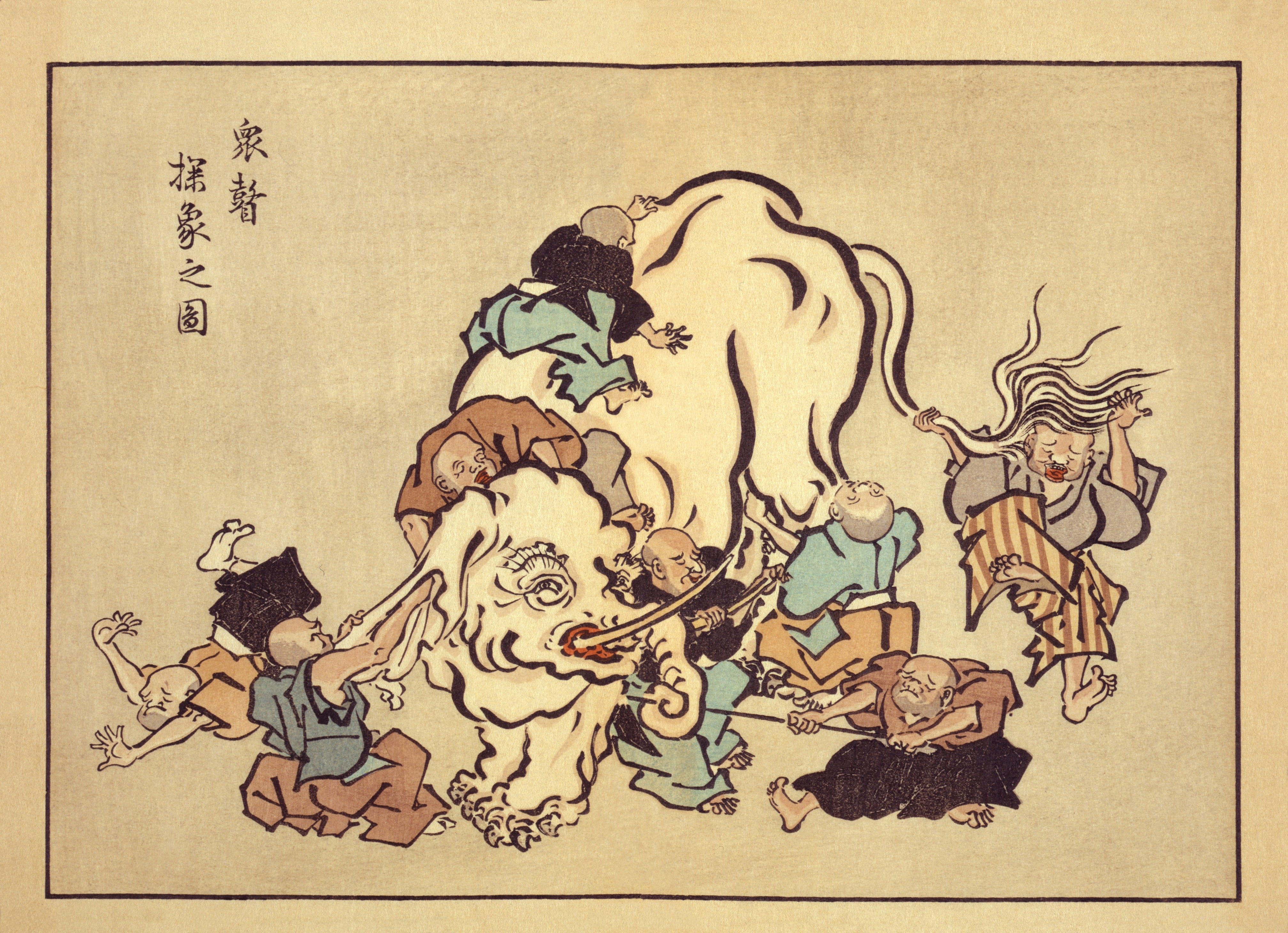
“Blind Monks Examining an Elephant,” Hanabusa Itcho
The Buddhist text Tittha Sutta, of the Khuddaka Nikāya, provides a powerful metaphor for this problem. A king gathers people who have been blind from birth and asks each of them to touch a different part of an elephant. The person touching its head compares the elephant to a jar; the one touching its ear compares it to a basket; others encounter the tusk, trunk, body, leg, tail, or tail tuft and offer different descriptions of the elephant. Each person has, in fact, perceived something real (fragments of reality), but each mistakes a partial experience for an account of the whole, distorting their worldview and leading them astray from the full comprehension of the phenomena. They dispute with one another because none recognizes the limitations of his own perspective. The parable was a warning against dogmatic attachment to partial views, but it is also an excellent analogy for modern PPE vis-à-vis modern academia. Economists may touch on the incentive structure, political scientists on the distribution of power, historians on the temporal development of institutions, and philosophers on the values through which arrangements are justified or condemned. Each can identify a genuine dimension of the social order. Yet, the shortcomings begin to creep in when one discipline assumes that its dimension exhausts the phenomenon or is enough to explain it entirely, and more dangerous still when they start advising public policies based on those partial views. An analysis of incentives may overlook legitimacy, coercion, or identity. An analysis of political power may neglect coordination, scarcity, and dispersed knowledge. A theory of justice may disregard feasibility, behavioral responses, and unintended consequences.
PPE must therefore do more than place partial descriptions beside one another. Its purpose is to bring them into interaction so that scholars can reconstruct more of the “elephant” of social reality. The disciplines, therefore, make distinct but complementary contributions. Philosophy supplies conceptual precision, logical rigor, critical reflection, and the normative languages through which institutions are justified or criticized. Political science examines public authority, collective action challenges, governance, political conflict, institutional development, and the distribution of power. Economics illuminates scarcity, incentives, exchange, coordination, property rights, markets, organizations, and the institutional foundations of prosperity. PPE should not erase these differences. It should organize them into a productive division of intellectual labor in which each discipline exposes and corrects the blind spots of the others.
This kind of integration also requires intellectual virtues. The blind men fail not because their observations are entirely false, but because each is too certain that a limited perception constitutes the whole truth. PPE scholars should cultivate epistemic humility, interpret rival perspectives charitably, and remain willing to revise their conclusions when another discipline reveals an omitted mechanism, value, or form of power. In the polarized societies in which we are living today, this is not merely an academic virtue. The capacity to reason across traditions and to understand why intelligent people disagree can help replace ideological trenches with more measured public argument. PPE cannot eliminate political conflict, but it can improve the intellectual terms on which conflict is conducted. PPE might therefore even become a civilizatory and anti-polarizing language by which we can understand each other more carefully, and understand the nuances of reality and shortcomings of our own viewpoints.
PPE scholars therefore—and echoing Elinor Ostrom dictum—should also engage in methodological integration and pluralism: the formal and empirical methods of economics and political science can illuminate complex questions concerning institutions, power, politics, and the organization of social life. Formal models can isolate mechanisms, expose tensions among assumptions, and clarify the possible consequences of alternative rules. Econometrics, causal inference, experiments, comparative analysis, case studies, and historical research can investigate whether those mechanisms operate, under what circumstances, and with what magnitude. At the same time, philosophy can enrich empirical social science by clarifying its concepts, assumptions, methodological blind spots, evaluative standards, and broader implications. Freedom, welfare, equality, consent, and domination cannot simply be inserted into formal models or datasets as though their meanings were self-evident. Philosophical analysis helps determine what should be measured, which comparisons matter, what critical assumptions are hidden in a model, and why a particular outcome should count as an improvement. Thus, the “methodological exchange” must be reciprocal: formal analysis and empirical evidence can discipline philosophical reflection by revealing the feasibility, institutional requirements, and consequences of competing ideals. Philosophy can help social scientists determine which questions matter, which values are at stake, and how social outcomes should ultimately be assessed. Normative theory that ignores incentives, knowledge limitations, and unintended consequences risks becoming institutionally empty. Empirical research that refuses to examine its conceptual and normative premises risks becoming technically sophisticated but morally directionless. Genuine integration occurs when evidence changes normative judgments, conceptual analysis changes empirical design, and institutional analysis changes how both problems and reforms are understood.
Following from these principles, we believe that PPE scholars should also compare institutions against feasible alternatives rather than against imaginary perfection. Markets may decentralize knowledge and facilitate coordination while producing unequal bargaining relationships. Democratic governments may provide public goods and protect rights while remaining vulnerable to rent seeking, bureaucratic failure, and majoritarian domination. Communities may foster solidarity and mutual assistance while enforcing conformity and excluding outsiders. The relevant question is rarely whether an arrangement is flawless. It is which feasible arrangement performs comparatively better, for whom, according to which values, and under which conditions. This comparative approach requires taking trade-offs seriously. Liberty can conflict with equality, accountability with decisiveness, participation with expertise, local autonomy with universal protection, and experimentation with stability. These are not merely technical constraints imposed on moral aspirations. They are—as Isahia Berlin suggests—genuine conflicts among important values. Refusing to recognize them does not make them disappear; it merely conceals the costs imposed by one’s preferred principles. PPE should identify trade-offs, investigate their empirical importance, and explain the moral reasons for resolving them in one direction rather than another.
Finally, we think that PPE scholars should aspire to become disciplined generalists. This does not mean abandoning specialized knowledge or acquiring superficial familiarity with many subjects. It means becoming sufficiently fluent in different modes of inquiry to recognize when a problem exceeds the boundaries of a single discipline, to collaborate effectively with specialists, and to understand how empirical, historical, analytical, and normative conclusions bear on one another. The disciplined generalist should know enough about the “entire elephant” to recognize when a technically sophisticated description of one part is being mistaken for an explanation of the whole. The PPE field also needs an orienting question broad enough to unite its diverse methods without dictating a single answer: what ethical, political, and economic foundations can sustain a peaceful, free, pluralistic, and prosperous social order? This question directs attention simultaneously to legitimacy, power, coordination, prosperity, and social coexistence. It also gives PPE a civic purpose. The field should educate scholars and citizens who can move between evidence and values, understand institutional complexity, and engage disagreement without reducing public life to just technical management or moral denunciation.
To conclude, what, then, should PPE scholars do? We believe that they should study how social orders work, how they distribute power and opportunity, how they facilitate or obstruct cooperation, how ideas shape them, and how they might be improved. They should treat institutions as both causal structures and moral objects. They should integrate philosophical judgment, formal reasoning, political analysis, historical understanding, and empirical evidence. They should approach social reform and progress pragmatically, not by seeking institutional perfection or radical revolution, but by identifying arrangements—at the margins—that allow diverse people to coexist, cooperate, revise their rules, and cope with persistent social problems. In an age in which increasingly powerful AI technologies can perform many technical tasks (such as writing), the distinctive contribution of PPE will lie even more in identifying the right and relevant questions, connecting fragmented forms of knowledge into a unified argument, clarifying the values at stake, and judging what the technically feasible is for. Above all, PPE scholars should remember the Indian parable of the elephant: PPE is not simply an interdisciplinary field. It is the disciplined attempt to overcome partial vision and develop a fuller understanding of the possibilities and limits of living together.
References
Berlin, I. 2013 [1988]. “The Pursuit of the Ideal.” In The Crooked Timber of Humanity. Princeton Press.
Buchanan, J. M. 1964. “What Should Economists Do?” Southern Economic Journal 30 (3): 213-222.
Hayek, F. A. 1967. “The Dilemma of Specialization.” In Studies in Philosophy, Politics and Economics. Chicago: University of Chicago Press.
Ostrom, E. 2009. “Beyond Markets and States: Polycentric Governance of Complex Economic Systems.” Nobel Prize Lecture, 2009, Stockholm.
Tittha Sutta: Sectarians (1), Udāna 6.4, Khuddaka Nikāya. Translated by Thanissaro Bhikkhu.
1. Any plans to have an essay in this series that compares the traditional PPE with the „new PPE“, namely, philosophy, psychology and economics? Warwick has had what's officially called „Economics, Psychology and Philosophy“ for, according to Gemini, about 5 years or so. LMU München was also planning to launch its „new PPE“ but the discussions went nowhere, I was told by someone who was involved.
2. Your essay claims near the beginning that tPPE should be about both „how ... people“ and „how ... institutions“ but in the conclusion para you fail to mention the first and list only institutions. Is this just a slip or are you seriously opposed to methodological individualism?
3. In relation to both #1 and #2, there is still no resolution in sight on the debate around microfoundations. The gap between „how people“ and „how ... institutions“ seems to be the hard problem of both tPPE and nPPE. Are you planning an essay on that? I am especially fond of Pettit's non-reductive MI as a response in this regard but what are the your or the authors-of-the-forthcoming-essays' thoughts (much more psychology in Pettit's research programme than tPPE)?
This is very interesting but it is very much not how PPE has been taught for nearly a century at Oxford - the most famous PPE degree. So I guess there is a difference between PPE as a research agenda and as a undergraduate degree. Without regards to the later, I wonder if there is a converse to Hayek's quip about no good economist being only an economist? That is, without specialist (that is, deep or rigorous) training in at least one and perhaps more than of the pillars of PPE, one will also not be a good PPE scholar?